DANG GIA HUY
As a Storyteller, I introduce myself to the world...
I was once a boy who found joy in simple things, looked up at the sky with curiosity, and found peace at the piano. As I grew older, I turned that curiosity into artificial intelligence, unmanned aerial vehicles, and medical technology. Yet, my deepest aspiration is not merely to build intelligent machines, but also to use science to expand opportunities, reach lives that are rarely heard, and help more children dare to dream bigger.


My Childhood Manuscript
I do not remember exactly where I took my first steps. Perhaps it was in a familiar courtyard, along a long hallway at home, or on an afternoon that the adults have long since forgotten. But I like to imagine that my first steps were always directed toward someone in my family.
When I was little, I did not yet know how to name the things that made me feel safe. I only knew that, in a crowded place, my first instinct was to reach for a loved one's hand; when I was tired, I wanted to be carried; and when I saw something unfamiliar, I would often look at the adults around me, as if asking, “Can I get closer?”
The world back then was much larger than I was. Chairs seemed taller than my head, roads stretched endlessly into the distance, and every family trip felt like an adventure.
Perhaps I cannot remember the names of the hotels, the roads, or the places where my family stopped along the way. But I like to believe that my body still remembers the feelings of those days: being held, being led by the hand, being waited for, and being loved even before I knew how to express anything in words.
Years later, when I look back at our family photographs, I realize something simple: before I stepped out into the world on my own, I already had a little world that walked beside me.


If I had to choose one image to tell the story of my childhood, I would not choose a distant trip or an expensive gift. I would choose the photograph of myself holding two ice cream cones, studying them as if I were facing a very serious problem.
In my imagination, that day began with a negotiation.
“I want this flavor.”
Then, once I had one cone in my hand, I looked at the other. Perhaps the second flavor was just as delicious. Perhaps eating only one meant missing out on something. For a child, choosing between two things he loves can sometimes be a much harder problem than adults imagine.
I wanted to taste both. I wanted to keep both. And I could not understand how adults could remain so calm when faced with choices like these.
In the photograph, I stick out my tongue to taste the ice cream, wearing an expression of complete concentration. If someone had asked what I was thinking, the answer probably would not have been profound: I was simply enjoying my treat.
Yet these are precisely the moments that make up childhood. When we are young, joy does not need a grand reason. An ice cream cone, an outing, or simply getting to do something we like can make an entire day memorable.
I do not know how many times I stained my shirt that day, or whether someone reminded me not to eat too quickly. Those details are part of the imagination I have added to the story. What the photograph truly preserves is a boy so happy that he does not care how he looks.
Sometimes, I think growing up is not about learning how to find more joy. It is about learning to preserve the innocence that once made two ice creams feel like an extraordinary day.


The Rules We Made Up as We Went Along
If there is one thing children do better than adults, it may be turning ordinary things into games.
A path in a park can become a racetrack. A patch of grass can become an entire kingdom. A bottle of soap bubbles can inspire dozens of missions that no adult would ever fully understand.
I imagine afternoons spent running around a yard with my siblings, inventing rules that were never written down. Whoever reached the tree first would win. Whoever caught the most bubbles would get to choose the next game. And if the result did not go our way, we could simply invent a new rule.
“That’s not fair! Let’s play again!”
Perhaps this is a familiar sentence in many households with young children.
Back then, I did not understand that an older brother, an older sister, or a younger sibling was more than just a playmate. They were also the people who witnessed the most unguarded versions of me: the moments of unreasonable sulking, the victories celebrated a little too enthusiastically, and the times when a simple apology was enough to make everything right again.
Photographs of siblings together cannot tell us how many times we argued. They preserve only the moments when we all looked toward the camera or laughed together during a game.
But I like to believe that behind every smile was an entire private world that only the children in our family could understand.
As we grow older, we may develop different interests, follow separate schedules, and have things we do not always share with one another. Yet the games of childhood taught me a kind of closeness that is difficult to replace: some people do not need to become our friends because they have been there since before we even knew what friendship meant.


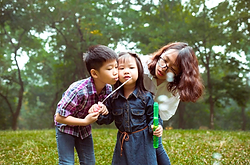


I remember the image of rocky islands rising from the blue waters of Ha Long Bay. At least, that is what I can see when I look back at the photographs: the vast sea, successive limestone formations, and my family standing on the deck of a boat.
I cannot be certain what I was thinking during that trip. But if I were to retell it through the imagination of a child, I would begin with a question.
“Dad, why are there mountains in the middle of the sea?”
Adults might explain geology, time, and natural processes that have unfolded over millions of years. A child, however, might only need to see a distant island to imagine that another world exists on the other side.
I wanted to discover what lay beyond those islands. Where would the boat go if it kept moving forward? Did the islands have their own names? Did anyone live there? If I could set foot on a small island, might I discover a hidden treasure or a secret cave?
Perhaps the adults saw nothing more than a family holiday. In my eyes at the time, if this story reflects the way a child might think, it could have been an expedition.
Later, I realized that a trip does not have to take us somewhere unfamiliar to become memorable. Sometimes, what matters more is the feeling of seeing something larger than anything we have ever known.
Some journeys end when the boat reaches the shore. Others continue inside our minds long afterward, in the form of unanswered questions.
Perhaps my curiosity began with little questions like these, long before I understood that curiosity could become a serious way of learning.


Some Days, I Spoke Through Piano Keys
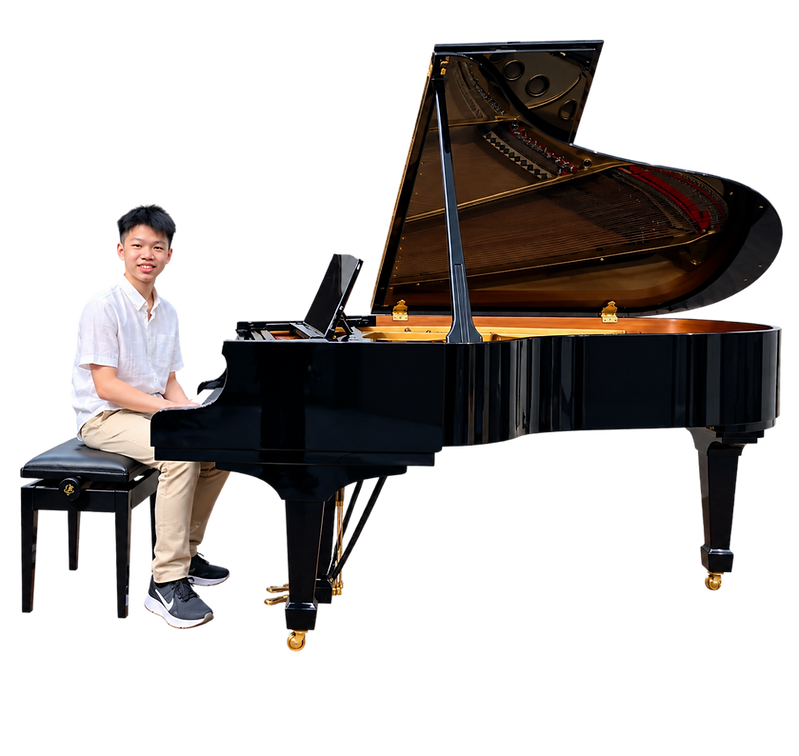
When I see myself sitting in front of a grand piano, I think of a different version of myself: no longer just a boy eager to run as fast as possible or explore everything in sight, but someone beginning to discover quiet moments of solitude. The piano looks much larger than I am, its black and white keys stretching before me in a room so quiet that I can almost imagine music filling the space before fading away. I do not know whether the photograph was taken after a lesson, practice session, or performance, so I imagine a possibility: perhaps there were days when I played the same passage over and over, struggling to make my fingers follow what I heard in my mind. A passage might make me confident on the first attempt and leave me confused by the tenth. Sometimes, the hardest part was not knowing what to do, but finding the patience to try again when the result fell short of my hopes.
I imagine placing my hands on the keys, pausing, and trying once more. Perhaps I sometimes wanted to skip the difficult parts and move straight to the sections I enjoyed; perhaps I felt happy simply because I had finally mastered something that had frustrated me throughout the session. Music teaches us that we cannot rush a piece into completeness: desire cannot replace hours of practice, and effort does not always bring immediate results. I do not want to turn the piano into an oversized symbol. It is still just an instrument, and I am still learning to play it. Yet ordinary things sometimes leave us with the most lasting lessons. There are things I can express in words and others I understand only through experience. On some days, when I do not know what to say, I can sit at the piano and let the music speak for me.
.png)


The Balls That Would Not Obey Me
I imagine my first tennis practice taking place on a sunny afternoon, with shoes scraping against the court and yellow balls flying across the net. I would soon discover that tennis is more than swinging a racket: I must track the ball’s trajectory, position my feet, adjust my stroke, and predict where it will land—all within seconds. At first, I might think hitting the ball as hard as possible is enough, only to watch shots fly out of bounds or strike the net. “Again!” I imagine telling myself after each missed shot, determined to understand what went wrong.
What fascinates me about sports is how every mistake offers a new lesson. I may know I arrived too late without understanding how to move my feet better, or see the ball veer off course without knowing how to adjust my racket. Some days, I would play well; on others, every shot might feel difficult. Yet progress could come from something as small as finally returning a ball I used to miss. Although I cannot determine my skill level from a few videos, I see in them a reminder that learning requires patience and persistence. The same lesson applies beyond the court: whether mastering a new skill, solving a difficult problem, or beginning an uncertain project, I must be willing to try again before I can improve.
When the Sky No Longer Felt So Far Away
My curiosity about the sky gradually grew into a deeper interest in science, engineering, and how things work. A red remote-controlled aircraft became more than a toy; it opened the door to questions about aerodynamics, aircraft structures, propulsion, and control systems. As I learned to observe how its components worked together, I began to see flight as the result of scientific principles brought to life through engineering. What once seemed distant and mysterious became something I could explore, understand, and experiment with, turning childhood fascination into a lasting interest in technology.

Bringing the Things I Love Closer to Other Children
As my interests in aviation and technology developed, I began to see their value beyond my own learning. Through Wings of Dreams, I brought model aircraft and virtual reality experiences to children in underserved communities, hoping to give them opportunities to explore ideas they might not otherwise encounter. Watching their curiosity emerge through questions, demonstrations, and hands-on experiences reminded me that technology is not meaningful only because of what it can accomplish, but also because of the doors it can open for others. I came to believe that sharing knowledge is one way to make opportunities more accessible, inspire young minds, and help children imagine futures beyond the limits of their current circumstances.


